

Ai and the Future of International Private Medical Insurance Brokers FAQs
- Written by: iPMI Global
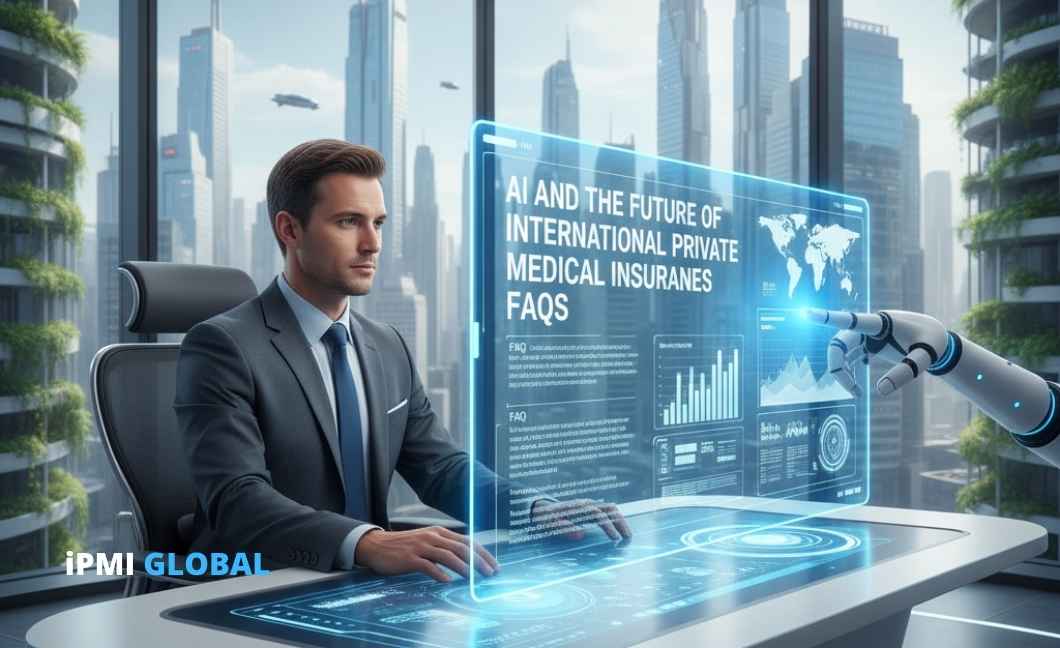
In this iPMI Global Insights article we answer the most frequently asked questions about this important topic.The anticipated impact of Artificial Intelligence (AI) on the role of International Private Medical Insurance (IPMI) brokers, predicting a shift towards a hybrid future driven by augmentation. AI is expected to automate highly routine tasks such as quoting, administrative paperwork, and basic client management using technologies like Natural Language Processing.
However, the sources emphasize that AI will not cause wholesale replacement, stressing that human brokers remain essential for complex advisory services, nuanced judgment regarding exceptions, and critical governance and regulatory compliance roles. Ultimately, the text defines the future broker as one who focuses on high-value relationship management and intricate placements, supported by AI that handles the speed and efficiency of standard operations.
Will AI completely replace International Private Medical insurance brokers?
This question lies at the heart of strategic planning for professionals across the insurance industry. It often evokes a fear of widespread job replacement, but the emerging reality is one of fundamental role transformation. The core of the issue is not whether brokers will exist, but how their value proposition will evolve in an AI-driven ecosystem.
The evidence clearly indicates that AI is not expected to cause a wholesale replacement of insurance brokers. Instead, the industry is poised for a significant transformation of the broker's role. This evolution involves a crucial distinction between the automation of routine, administrative tasks and the preservation of critical advisory and relationship-based functions. While AI will handle the former with increasing efficiency, the latter will become an even more vital differentiator for human brokers. Understanding which specific tasks will be automated is the key to navigating this industry-wide transformation.
Which International Private Medical Insurance broker tasks are most likely to be automated by AI?
Automation is a primary driver of AI adoption within the insurance workflow, delivering its most immediate and measurable value by targeting manual, administrative, and repetitive tasks. Consequently, this automation directly targets the operational core of high-volume, low-complexity brokerages. Roles centred on standard quoting and administrative processing are not just at risk of disruption; their fundamental value proposition is being redefined by technology.
The specific International Private Medical Insurance broker activities most susceptible to automation include:
Automated Quoting and Scope-Matching
AI-powered intake systems, using Natural Language Processing (NLP) forms or chatbots, can efficiently extract applicant data from responses, CVs, and medical histories. This information is then used to pre-populate quotes and automatically match insurance products to the applicant's needs, significantly speeding up placement for standard expatriate risks and group renewals.
Administrative Tasks
Core administrative duties are prime candidates for automation. This includes simple quoting, generating policy documents, and completing Know Your Customer (KYC) paperwork. Technologies like Optical Character Recognition (OCR) and NLP can process documents and apply heuristics to streamline compliance checks for Anti-Money Laundering (AML) and eligibility verification, drastically reducing manual paperwork.
Client Management
Predictive models can analyse client data to identify groups with a high probability of churn or high future costs. This capability allows for automated renewal alerts that trigger proactive engagement from brokers, enabling them to intervene strategically rather than reactively.
While these automated processes will redefine efficiency, they also sharpen the focus on the uniquely human skills that AI cannot replicate.
Why won't International Private Medical Insurance brokers be wholly replaced? What are the essential human roles?
In high-stakes, complex environments like IPMI, human judgment remains indispensable. While AI excels at executing standardized processes at scale, its limitations in handling nuance, building trust, and navigating intricate regulatory landscapes create a greater demand for human expertise in specific, high-value areas. The automation of routine work elevates the human role, freeing brokers to concentrate on functions where their skills are most critical.
The essential roles where a human presence will remain vital, and even grow in importance, include:
Complex Advisory & Relationship Management: Senior brokers will continue to be central to managing complex corporate placements, designing intricate benefit packages, and cultivating crucial client relationships. Their value is derived from deep industry knowledge, strategic thinking, and the ability to navigate complex cross-border advisory challenges—qualities that AI cannot currently replicate.
Exception Management: As AI systems handle the vast majority of standard cases, the primary function of human brokers will shift toward managing the exceptions. This includes correcting errors, handling unique cases that fall outside standard parameters, and applying the nuanced judgment required for complex risk assessments.
Governance and Regulation: The adoption of AI introduces a new class of professional roles focused on oversight and compliance. These include AI supervisors, model validators, and data ethicists responsible for ensuring that AI systems operate fairly, transparently, and in adherence with fragmented global regulations. These roles are critical for managing the risks of algorithmic bias and exclusion and ensuring ethical outcomes.
These essential human roles are the cornerstones of a new, collaborative model where technology and human expertise work in concert.
What does the "hybrid future" of augmentation actually look like?
The most pragmatic path forward is not a binary choice between humans and machines, but a model of augmentation. This approach centres on creating a synergistic partnership where AI supports and enhances human decision-making rather than operating independently. This hybrid model combines the speed and analytical power of AI with the judgment, empathy, and strategic insight of experienced professionals.
The core principles of this augmented model are:
Focus on Augmentation: AI's primary function is to accelerate and improve the accuracy of specific tasks, such as data collection and initial risk assessment. Humans remain in control, managing exceptions, providing oversight, and making final strategic decisions.
"Human-in-the-Loop" Design: This is a critical design principle for responsible AI implementation. It establishes confidence thresholds where the AI can operate autonomously on low-risk tasks but must flag significant or adverse decisions for human review. For instance, an AI might suggest a policy action, but a human broker or underwriter must provide final approval for significant adverse actions, such as declines or large-value non-standard pricing.
Workforce Reskilling: A successful transition to a hybrid model requires a strategic investment in people. This involves reskilling and retraining staff for new roles like digital broking and AI supervision. The workforce's focus must shift away from administrative execution and toward the complex advisory and relationship-management tasks that AI cannot perform.
This augmented approach represents a practical and powerful evolution, transforming the broker's toolkit and enabling a higher standard of service.
Conclusion: From Task Execution to Strategic International Private Medical Insurance Advisor
iPMI Market Analyst Christopher Knight concludes, “The future for insurance brokers is not one of obsolescence but of profound evolution. The analysis of the IPMI sector offers a clear blueprint for the broader brokerage industry: a fundamental shift away from routine task execution and toward high-value strategic functions. In this new landscape, brokers will thrive by leveraging powerful AI automation tools to handle administrative burdens, allowing them to dedicate their expertise to what matters most—providing complex advice, managing strategic client relationships, and ensuring the ethical governance of the very systems that support them.”




